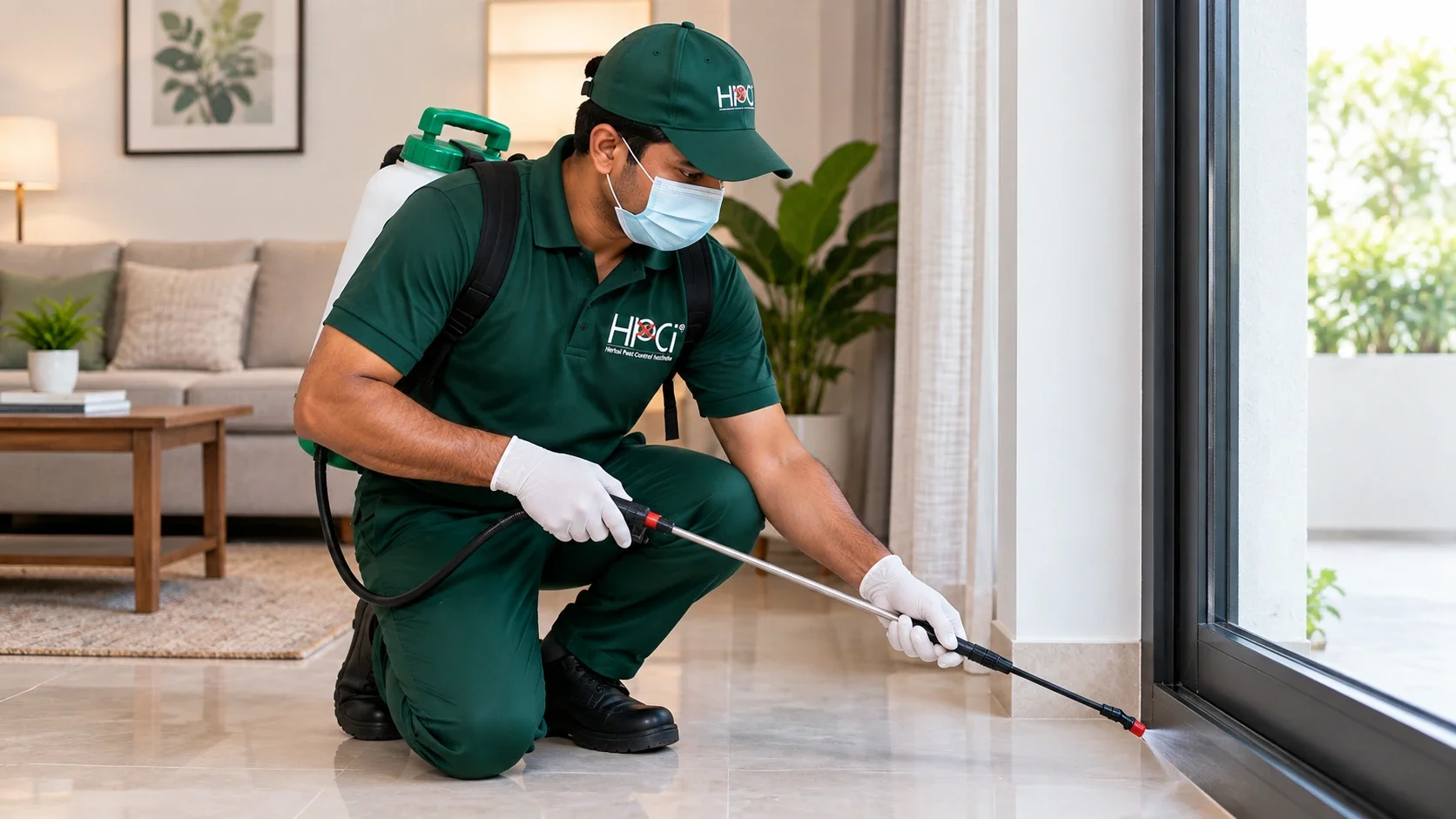
Discover what herbal pest control is, how plant-based pest treatments work, where they can help, their limitations, and what to consider before choosing professional pest management.
If you are searching for pest control but are concerned about the type of treatment being used inside your home or workplace, you may have come across the term herbal pest control.
But what does it actually mean?
Is herbal pest control simply another name for natural pest control? Can it manage cockroaches, termites, mosquitoes, rodents or bed bugs? Is it suitable for homes with children or pets? And how is it different from conventional pest-control treatments?
These are reasonable questions to ask before choosing a pest-control service.
Herbal pest control generally refers to pest-management approaches that use plant-derived, botanical or herbal-based formulations as part of the treatment process. The exact ingredients, formulation and method of application can vary between products and pest-control providers.
At HPCI, our approach is centered around herbal and plant-based pest management. But we believe customers should understand what a treatment actually involves rather than choosing a service simply because it is labelled "herbal."
This guide explains how herbal pest control works, where it may be useful, what its limitations are and what you should consider before booking a professional treatment.
What Is Herbal Pest Control?
Herbal pest control is a form of pest management that uses plant-based, botanical or herbal-derived formulations to help manage pest activity.
Depending on the formulation and application, plant-derived ingredients may be used to discourage, repel, control or manage specific pests.
Common botanical ingredients used in pest-management products can include plant-derived materials such as neem, eucalyptus, citronella and pyrethrum-derived compounds. However, the actual formulation differs from one product to another.
That is why the term "herbal" by itself does not tell you everything about a treatment.
Before choosing a service, it is reasonable to ask:
-
What formulation is being used?
-
Which pest is it designed to manage?
-
Where will it be applied?
-
How will it be applied?
-
What preparation is required?
-
What precautions should be followed?
-
Is follow-up treatment necessary?
A professional pest-control provider should be able to explain these points clearly.
How Does Herbal Pest Control Work?
The exact mechanism depends on the pest and the formulation being used.
A professional herbal pest-management program may work by using botanical ingredients with properties that can help repel, deter or control specific pests.
But pest control is rarely about the formulation alone.
The property itself also matters.
For example, imagine you have cockroaches appearing every night in your kitchen.
A treatment may help manage the existing pest activity, but if the property still has:
-
Food residue
-
Leaking pipes
-
Open garbage
-
Moisture
-
Cracks
-
Hidden spaces
-
Easy entry points
the conditions supporting cockroach activity may remain.
This is why effective pest management combines treatment with prevention.
Herbal Pest Control Is Not the Same as Simply Using Household Remedies
There is an important difference between professional herbal pest control and a home remedy.
You may have heard suggestions such as:
-
Spraying diluted essential oils
-
Using neem leaves
-
Placing herbs around rooms
-
Using household ingredients
-
Cleaning areas with natural products
Some household practices may help discourage certain pests or improve general hygiene.
But that does not automatically make them a complete pest-control solution.
A professional pest-management service involves understanding:
Which pest is present → where it is active → what conditions support it → what treatment is appropriate → how recurrence can be reduced.
That is a much broader process than simply placing a natural ingredient in an affected room.
Why Are People Interested in Herbal Pest Control?
The way people think about pest control has changed.
Many homeowners and businesses want to know more about the products and methods being used inside their properties.
This is especially relevant in places such as:
-
Kitchens
-
Bedrooms
-
Living spaces
-
Offices
-
Restaurants
-
Hotels
-
Schools
-
Commercial premises
Some customers therefore ask specifically about plant-based or herbal approaches before booking pest control.
Their questions are usually practical:
What is being applied?
Where will it be applied?
How should we prepare the property?
What precautions should we take?
What should we expect after treatment?
These are the right questions.
What Are the Potential Benefits of Herbal Pest Control?
The suitability of a herbal approach depends on the pest, property and formulation. However, there are several reasons customers may consider it.
Herbal pest-management products can use ingredients derived from plants or botanical sources.
This is one of the main reasons customers specifically seek these approaches.
Suitable for Different Property Types
Depending on the treatment, herbal pest management can be considered for residential and commercial properties.
Pest-Specific Treatment
Professional treatment should still be selected according to the pest.
Cockroaches, termites, mosquitoes, rodents and bed bugs behave differently, so they should not automatically receive the same treatment.
Focus on Prevention
A good pest-management approach doesn't stop at treatment.
It also looks at the conditions that may allow pests to return.
Does Herbal Mean Chemical-Free?
This is one of the most important questions to clarify.
The terms herbal, plant-based, natural and chemical-free are sometimes used interchangeably in marketing, but they should not automatically be treated as identical.
A product can be plant-derived while still containing active compounds that have a specific biological effect.
Therefore, don't choose a pest-control service simply because a company uses the phrase "chemical-free."
Instead, ask the provider to explain:
-
What product or formulation is being used?
-
What are its active ingredients?
-
How is it applied?
-
What precautions are required?
-
What areas are treated?
At HPCI, we prefer explaining the treatment approach rather than asking customers to rely on a label alone.
Transparency is more useful than a marketing phrase.
Is Herbal Pest Control Safe?
This question needs a careful answer.
"Herbal" does not automatically mean that a product can be used without precautions.
Any pest-control treatment should be used according to the product instructions and the professional's application guidelines.
The appropriate precautions can depend on:
-
The formulation
-
Concentration
-
Application method
-
Treated area
-
Type of property
-
People using the space
-
Presence of pets
-
Pest being treated
If you have children, pets, elderly family members or anyone with particular sensitivities in the property, tell the pest-control provider before treatment.
A responsible service provider should explain any preparation and post-treatment instructions relevant to the treatment being performed.
Can Herbal Pest Control Be Used in Homes?
Yes, herbal pest-management approaches can be considered for residential pest problems, depending on the pest and treatment requirements.
Common household pest concerns include:
-
Cockroaches
-
Ants
-
Mosquitoes
-
Termites
-
Rodents
-
Bed bugs
-
Flies
But the treatment should be based on the actual pest problem.
For example, a family noticing a few ants around the kitchen may need a very different response from a family dealing with a widespread cockroach infestation.
The right starting point is identification and assessment, not simply selecting the most advertised treatment.
Herbal Pest Control for Cockroaches
Cockroaches are among the most common household pests.
You may notice them:
-
Around kitchen cabinets
-
Behind appliances
-
Under sinks
-
Around drains
-
Near food-storage areas
-
In utility spaces
If you see a cockroach once, basic cleaning and inspection may be a sensible first step.
But repeated sightings can indicate a larger problem.
A professional cockroach-management service can assess where the activity is occurring and determine the appropriate treatment.
Treatment should also be supported by:
Herbal Pest Control for Termites
Termites need to be approached differently from surface-level household pests.
They can remain hidden inside or around wooden structures.
Signs may include:
If you suspect termites, don't assume that replacing the damaged wood solves the problem.
The source of the activity should be assessed.
Termite treatment can require a more targeted approach based on the structure and extent of activity.
Herbal Pest Control for Mosquitoes
Mosquito management requires attention to the surrounding environment.
If mosquitoes keep appearing, look for:
A treatment may help manage mosquito activity, but if standing water remains, the underlying conditions may continue supporting mosquito breeding.
For this reason, mosquito management is both a treatment and a property-maintenance issue.
Herbal Pest Control for Rodents
Rodent control is another situation where treatment alone is not enough.
If you are finding:
-
Droppings
-
Chewed packaging
-
Scratching sounds
-
Damaged materials
-
Nesting signs
you should look for possible entry points and food sources.
A professional rodent-management approach should consider where rodents are entering and what is attracting them.
Simply removing a visible rodent without addressing access points can leave the property vulnerable to recurring activity.
Herbal Pest Control for Bed Bugs
Bed bugs can be particularly frustrating because they hide in small, concealed spaces.
Check:
If bed bug activity is suspected, treating only the mattress may not be enough.
The surrounding environment should also be assessed.
Because bed bugs can be difficult to locate, professional inspection and targeted treatment may be more appropriate for an established infestation.
What Is the Difference Between Herbal and Conventional Pest Control?
The main distinction is generally the type of formulation or treatment approach being used.
But the broader pest-management process can still involve similar principles:
Inspect → Identify → Treat → Prevent → Monitor
The biggest mistake is thinking that the formulation alone determines whether pest control will work.
It doesn't.
The result can also depend on:
A good pest-control service therefore looks beyond the product.
When Herbal Pest Control May Not Be Enough on Its Own
There are situations where a pest problem may require a more detailed or specialized approach.
For example:
-
A large termite infestation
-
Widespread bed bug activity
-
Persistent rodent entry
-
Severe cockroach infestation
-
Recurring pest activity across multiple areas
-
Structural conditions allowing pests to enter repeatedly
In such situations, the important question is not:
"Is herbal treatment better?"
The better question is:
"What treatment approach is appropriate for this particular pest problem?"
A trustworthy pest-control company should be willing to tell you when a particular approach may not be sufficient on its own.
What Should You Ask Before Booking Herbal Pest Control?
Before booking a service, ask these questions.
1. What Pest Are You Treating?
A treatment should be selected according to the pest.
Ask what type of plant-based or herbal formulation is being applied.
3. Where Will It Be Applied?
Understand whether the treatment is for kitchens, bedrooms, outdoor areas, structural spaces or other locations.
4. What Preparation Is Required?
You may need to store food, clear areas or move certain belongings.
5. What Precautions Should I Follow?
Ask about people, pets and treated areas.
6. Will Follow-Up Be Required?
Some pest problems require additional monitoring or treatment.
7. What Can I Do to Prevent Recurrence?
The answer should include practical property-management advice.
If a company is willing to answer these questions clearly, you have a better basis for making a decision.
How to Prepare Your Home for Herbal Pest Control
Preparation depends on the treatment, but some general steps can make the process easier.
Store Food Properly
Keep food covered and stored appropriately.
Clear Access
Make affected areas accessible to the technician.
Reduce Unnecessary Clutter
Clutter can create hiding places and make inspection more difficult.
Follow Specific Instructions
The technician should tell you if additional preparation is required.
Tell them about children, pets or other relevant household considerations before treatment.
Don't follow generic preparation advice if your pest-control provider has given you specific instructions for the treatment being performed.
What Should You Do After Herbal Pest Treatment?
Treatment is only one part of pest management.
After treatment:
Keep Food Sealed
Don't leave exposed food around kitchens and dining areas.
Control Moisture
Repair leaks and avoid unnecessary water accumulation.
Manage Waste
Dispose of food waste regularly.
Maintain Drains
Keep drainage areas clean and functional.
Check Entry Points
Seal or address suitable gaps where practical.
Monitor Pest Activity
If the problem continues, inform the pest-control provider instead of simply repeating random household treatments.
Does Herbal Pest Control Prevent Pests From Returning?
No pest-control method should be presented as a guarantee that pests will never return.
Pest recurrence can depend on many factors.
For example:
-
New pests can enter the property.
-
Food sources can remain available.
-
Moisture problems can continue.
-
Structural entry points may remain open.
-
Neighbouring properties can have pest activity.
-
Weather and environmental conditions can change.
This is why pest management should be viewed as an ongoing process of treatment + prevention + monitoring.
Herbal Pest Control for Businesses
Businesses can also consider herbal or plant-based pest-management options where appropriate.
Commercial properties may include:
-
Restaurants
-
Hotels
-
Offices
-
Shops
-
Warehouses
-
Educational facilities
-
Other workplaces
The pest-management requirements of a restaurant can be very different from those of an office.
For example, a restaurant needs particular attention to:
-
Food storage
-
Kitchens
-
Drains
-
Waste areas
-
Equipment spaces
A warehouse may have greater concerns around:
-
Storage
-
Packaging
-
Loading areas
-
Rodent entry
-
Large concealed spaces
The treatment should therefore be based on the actual business environment.
Herbal Pest Control Is Not a Replacement for Good Hygiene
This is worth emphasizing.
Even the best pest-management program cannot compensate for conditions that continuously attract pests.
For example, cockroach management can become more difficult when food waste and moisture remain available.
Mosquito management becomes harder when standing water continues to collect.
Rodent problems can continue when food and entry points remain accessible.
Therefore:
Professional treatment + good property maintenance = better pest management.
How HPCI Approaches Herbal Pest Management
At HPCI, our pest-management approach is built around herbal and plant-based formulations.
We work with residential and commercial pest problems, including common concerns such as cockroaches, termites, mosquitoes, rodents, bed bugs, ants and flies.
Our approach is not simply about applying a product and leaving.
We believe customers should understand:
-
What pest is being managed
-
Where the activity is occurring
-
What treatment is appropriate
-
How the property should be prepared
-
What should be done after treatment
-
What can help reduce recurrence
That is particularly important when customers are specifically looking for herbal pest control.
A treatment should be explained clearly enough that the customer understands what they are choosing.
Who Should Consider Herbal Pest Control?
You may want to explore herbal pest-management options if:
-
You prefer plant-based pest-management formulations.
-
You want to understand the treatment being applied in your property.
-
You are dealing with recurring household pests.
-
You manage a commercial property and want to discuss available treatment approaches.
-
You want professional pest management rather than relying only on household remedies.
But the decision should still be based on the actual pest problem.
If you're dealing with termites, for example, you should choose a provider that understands termite behaviour and treatment—not simply a provider because it uses the word "herbal."
When Should You Call a Professional?
Consider professional pest control when:
-
The same pest keeps returning.
-
Multiple areas of the property are affected.
-
You find signs of termites.
-
Rodents are repeatedly entering.
-
Bed bugs are continuing to appear.
-
Cockroach activity is increasing.
-
Mosquitoes remain a persistent problem.
-
You cannot identify where the pests are coming from.
-
DIY treatment has only provided temporary relief.
A professional assessment can help determine whether treatment is actually needed and what type of approach is appropriate.
Frequently Asked Questions About Herbal Pest Control
What is herbal pest control?
Herbal pest control is a pest-management approach that uses plant-derived, botanical or herbal-based formulations to help manage specific pest problems.
Is herbal pest control the same as natural pest control?
The terms are sometimes used similarly, but they are not necessarily identical. Ask the provider what formulation and ingredients are actually being used.
Is herbal pest control completely chemical-free?
You should not assume that "herbal" automatically means "chemical-free." Ask the provider for details about the formulation and treatment process.
Can herbal pest control be used in homes?
Depending on the pest and formulation, herbal pest-management approaches can be considered for residential properties. Treatment should be selected according to the specific pest problem.
Can herbal pest control control cockroaches?
A professional herbal pest-management approach may be considered for cockroach problems, depending on the formulation and infestation. Property conditions such as food, moisture and entry points should also be addressed.
Can herbal pest control be used for termites?
Termite management requires a pest-specific approach. If termites are suspected, the affected structure should be inspected before deciding on treatment.
Is herbal pest control suitable for businesses?
It can be considered for commercial properties depending on the pest, formulation and operating environment.
How long does herbal pest control last?
There is no single duration that applies to every treatment. Results can depend on the pest, infestation, property conditions, treatment approach and recurrence factors.
Will herbal pest control stop pests permanently?
No responsible pest-control provider should promise that pests can never return. New pests can enter and property conditions can change. Prevention and monitoring remain important.
What should I ask a pest-control company before treatment?
Ask about the pest being treated, formulation, application areas, preparation, precautions, follow-up and prevention recommendations.
Final Thoughts
So, what is herbal pest control?
In simple terms, it is a pest-management approach that uses plant-derived, botanical or herbal-based formulations to help manage specific pest problems.
But the real value of professional herbal pest control is not simply the word "herbal."
It is the complete approach:
Identify the pest → understand the problem → choose the appropriate treatment → apply it correctly → improve the conditions around the property → monitor the result.
If you're considering herbal pest control for your home or business, don't be afraid to ask questions.
Find out what is being used, where it will be applied, what preparation is required and what you can do afterward to reduce the chances of the problem returning.
At HPCI, we believe good pest control should be understandable, practical and honest about what treatment can and cannot achieve.
The goal isn't simply to remove the pest you can see. The goal is to understand why the pest is there and manage the problem in a way that makes sense for your property.