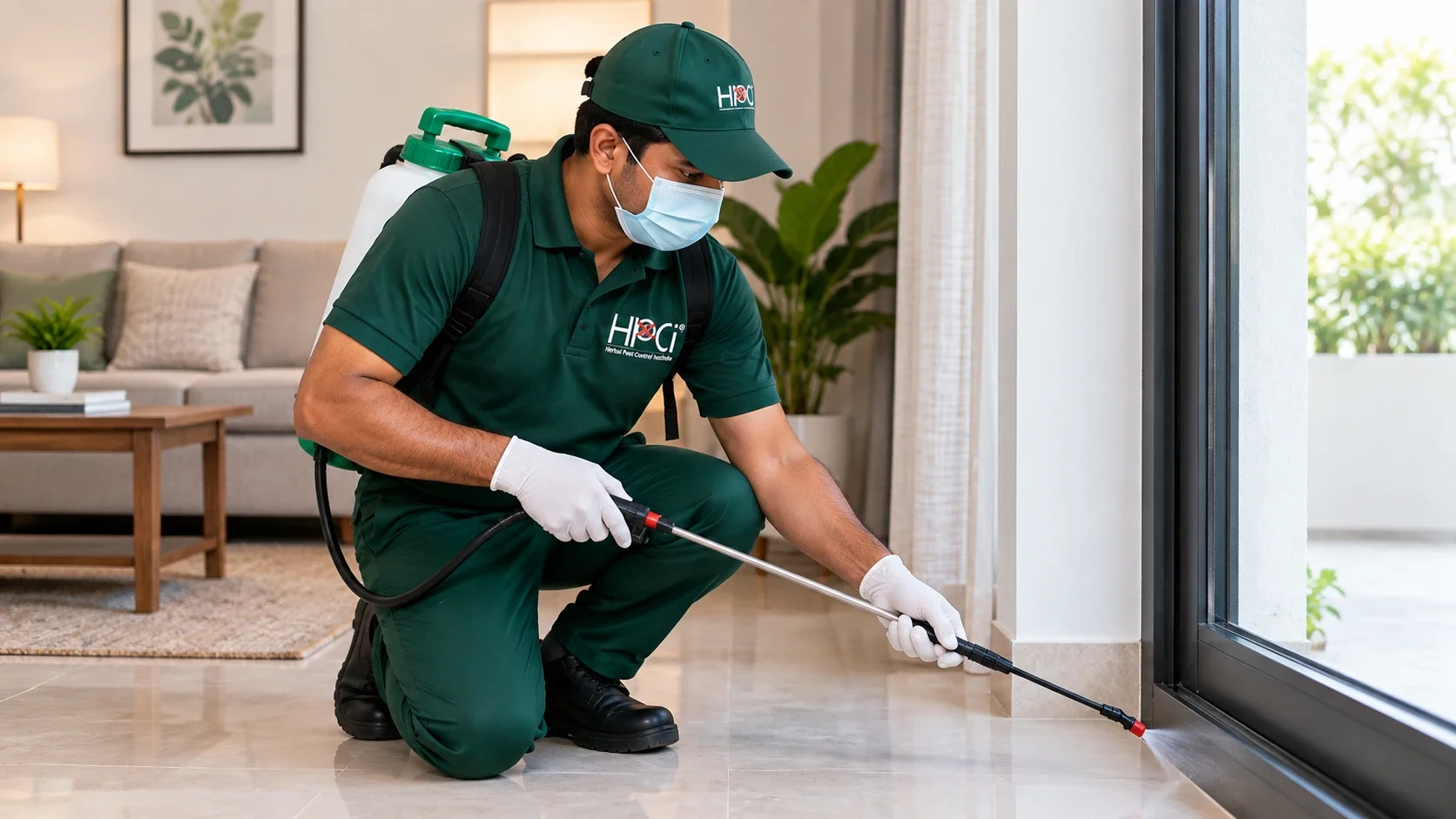
Discover how pest control services in Raipur work with Herbal Pest Control Institute’s practical approach to managing termites, cockroaches, rodents, mosquitoes, bed bugs, and other common pests through herbal and preventive solutions.
When a customer contacts us about pest control services in Raipur, the problem is rarely limited to seeing one cockroach, rat, termite, mosquito, or bed bug. Usually, there is a bigger concern behind that first sighting: Where are these pests coming from? Are they multiplying? Is my family or business at risk? Will they come back after treatment?
At Herbal Pest Control Institute (HPCI), we believe pest control should begin by understanding the actual problem rather than simply treating the pest that happens to be visible. Our team looks at the type of pest, where activity is occurring, possible entry points, food and water sources, hiding areas, and the conditions that may allow the infestation to continue.
HPCI provides herbal pest-control services through its branches in Nagpur, Indore, and Raipur, with services for residential and commercial properties. Our Raipur branch is located at Ashoka Heights, E505, Vidhan Sabha Road, Mowa, Raipur, Chhattisgarh 492005.
In this guide, we want to share a practical view of pest management based on the way our team approaches pest problems. If you are a homeowner, tenant, shop owner, restaurant operator, office manager, or property owner in Raipur, this guide can help you understand when professional pest control is needed, what to expect from a treatment, and what you can do to prevent pests from returning.
Why Pest Control Services in Raipur Are Important
One thing we have noticed in pest management is that people often wait until a pest problem becomes obvious before taking action.
A homeowner may ignore one cockroach.
A shopkeeper may overlook a few ants.
A restaurant may try to manage flies on its own.
A family may assume that one rat entering the kitchen is an isolated incident.
But when the same problem keeps appearing, it usually makes sense to look for the reason behind it.
Pests need suitable conditions to survive. Food, water, warmth, shelter, waste, moisture, and access points can all contribute to pest activity. Even a property that is cleaned regularly can experience pests if rodents can enter through structural gaps or mosquitoes can breed in standing water.
This is why professional pest control services in Raipur should focus on both pest treatment and pest prevention.
Our goal at HPCI is not simply to remove what the customer can see. We want to understand what is allowing the pest to remain on the property in the first place.
What Pest Problems Can Occur in Raipur Properties?
Different properties experience different pest challenges.
HPCI provides herbal pest-control treatments for common pests including cockroaches, termites, mosquitoes, rodents, bed bugs, ants, flies, spiders, and agricultural pests.
The right treatment depends on the pest and the property.
Cockroach Infestation
Cockroaches are among the most common indoor pest concerns.
Customers often notice them:
- In kitchens
- Near sinks
- Behind refrigerators
- Around drains
- Inside cabinets
- Near garbage areas
- In bathrooms
- Around food-storage areas
One of the problems with cockroaches is that they can remain hidden for long periods. If you are repeatedly seeing them, particularly at night, it is worth checking the surrounding areas rather than treating only the visible insect.
Termite Infestation
Termites can cause damage quietly.
They may affect:
- Wooden doors
- Furniture
- Window frames
- Flooring
- Wooden cabinets
- Skirting
- Other wooden structures
Signs such as hollow-sounding wood, mud tubes, discarded wings, or visible termite activity should not be ignored.
At HPCI, termite treatment begins with inspection and assessment so the affected areas and possible termite pathways can be understood before treatment is recommended.
Mosquito Problems
Mosquitoes can become a problem around homes, offices, gardens, commercial properties, and other outdoor areas.
Standing water in coolers, containers, plant pots, drains, tyres, and other locations can create potential breeding areas.
Our mosquito-control approach includes identifying breeding zones and using treatment methods suited to the property.
Rodent Infestation
Rats and mice can create both hygiene and property concerns.
Signs include:
- Droppings
- Gnaw marks
- Damaged food packets
- Scratching sounds
- Nesting material
- Rodent odour
- Repeated sightings
HPCI's Raipur rodent-control service uses humane trapping and plant-based repellents, while technicians identify potential structural gaps and advise on measures to reduce re-entry.
Bed Bugs
Bed bugs can be difficult to manage because they hide in mattresses, furniture, cracks, and other sheltered areas.
If bites continue to appear or you notice signs around sleeping areas, professional inspection can help determine whether bed bugs are present.
Ants and Flies
Ants are often attracted by accessible food and water, while flies may become a problem around food, waste, drains, and organic material.
The important question is not simply how to remove the insects you see, but what is attracting them to that location.
How Do You Know When You Need Professional Pest Control?
We don't believe every single insect requires a professional treatment.
Seeing one mosquito or one ant does not automatically mean that you have an infestation.
However, repeated pest activity is different.
You may want professional assistance when:
- Pests keep appearing after cleaning
- The number of pests seems to be increasing
- Pest activity is visible in multiple rooms
- Food or stored goods are being damaged
- You notice termite signs
- Rats or mice are entering your property
- Bed bugs continue appearing
- Mosquito activity remains high
- DIY methods provide only temporary relief
- Pest activity is affecting your business
- You are unsure where the infestation is coming from
Our advice is simple: don't panic after seeing one pest, but don't ignore repeated signs either.
Early assessment can help you understand the problem before it becomes more difficult to manage.
How We Approach Pest Control Services in Raipur at HPCI
At Herbal Pest Control Institute, we follow a simple principle:
Understand first. Treat second. Prevent next.
Our published service process includes inspection and assessment, a customized treatment plan, safe application, and follow-up support.
1. Inspection and Assessment
The first step is to understand where the pest activity is occurring.
Depending on the pest, our technicians may inspect:
- Kitchens
- Bedrooms
- Bathrooms
- Storage areas
- Drains
- Outdoor areas
- Wooden structures
- Food-storage areas
- Garbage zones
- Possible entry points
The purpose is to understand the infestation rather than make assumptions.
2. Identify the Pest
Different pests behave differently.
A cockroach problem cannot be approached in exactly the same way as a termite problem.
Likewise, rodent management requires a different strategy from mosquito control.
Correct pest identification helps determine the appropriate treatment and prevention measures.
3. Understand the Property
We also consider how the property is used.
A house, restaurant, office, warehouse, hospital, farm, and shop can have very different pest risks.
For example, food businesses need particular attention to food storage, waste, drains, and hygiene conditions.
4. Create a Suitable Treatment Plan
Once the situation is understood, an appropriate treatment plan can be recommended.
HPCI describes its approach as using plant-based and botanical formulations, including ingredients such as neem, citronella, eucalyptus, and other botanical actives.
5. Apply the Treatment
Treatment is carried out according to the pest and property conditions.
Our team focuses on applying the appropriate method to the relevant areas rather than treating a property without considering where the pest activity is occurring.
6. Follow-Up and Prevention
For some pest problems, follow-up is an important part of management.
HPCI states that its process includes follow-up support and free re-treatment where required under its service approach.
We also advise customers about practical prevention measures that can reduce the chance of recurring activity.
Why We Use a Herbal Pest Control Approach
At HPCI, our service is built around herbal and plant-based pest management.
The company states that its treatments use botanical ingredients such as neem, eucalyptus, citronella, clove, and pyrethrum, with the aim of providing pest control while reducing reliance on conventional harsh chemical formulations.
For us, calling a service “herbal” should not be the end of the conversation.
Customers should also understand:
- What pest is being treated
- Why a particular method is recommended
- Where the treatment is applied
- What preparation is needed
- What precautions should be followed
- What prevention steps are recommended afterward
That is why we try to explain the treatment process rather than simply telling customers that it is herbal.
Are Herbal Pest Control Services in Raipur Suitable for Homes?
For homeowners, one of the biggest concerns is often what happens to the family during treatment.
People want to know whether children, elderly family members, and pets need to leave the property.
HPCI states that its plant-based formulations are designed to allow customers to remain on the premises during and after treatment and describes them as odorless and non-toxic.
However, customers should always follow the specific instructions given by the pest-control technician for the particular treatment being performed.
Preparation requirements can vary depending on the pest, location, treatment method, and property.
Pest Control for Restaurants and Food Businesses in Raipur
Restaurants and food businesses need to take pest activity seriously.
Cockroaches, rodents, flies, ants, and other pests can enter areas where food is stored, prepared, or served.
For food businesses, we recommend paying particular attention to:
- Food-storage areas
- Kitchen drains
- Garbage areas
- Delivery entrances
- Storage rooms
- Cracks and gaps
- Water leakage
- Food residue
- Cleaning schedules
Pest control should work alongside daily hygiene and food-safety practices. It should not be considered a replacement for proper sanitation.
HPCI states that it is FSSAI compliant and provides pest-control solutions for food businesses and other commercial environments.
Pest Control for Offices and Commercial Properties
An office may not have the same pest risks as a restaurant, but pest activity can still develop.
Common problem areas include:
- Office pantries
- Cafeterias
- Washrooms
- Storage rooms
- Parking areas
- Utility spaces
- Waste bins
- Building entry points
For commercial properties, regular inspection can help identify pest activity before it becomes disruptive.
A good commercial pest management plan should consider how employees use the building, where food is stored, where waste is kept, and where pests could enter or hide.
Why DIY Pest Control May Not Solve a Recurring Problem
We understand why customers try DIY pest control first.
If you see a cockroach, you may use a household product.
If you see ants, you may clean the area.
If you see a mosquito, you may use a repellent.
These actions may be useful for minor situations.
But recurring infestations require a different approach.
Imagine you see a rat in your kitchen and remove it. If the rat entered through an opening near a pipe, another rodent could potentially use the same route.
Similarly, spraying one area where cockroaches are visible may not address hidden activity elsewhere.
The problem isn't always the pest you see.
The problem may be the conditions that allow the pest to keep coming back.
That is where professional inspection becomes useful.
How Can You Prevent Pests After Treatment?
Professional pest treatment is only one part of long-term pest management.
The property owner also has an important role.
Keep Food Properly Stored
Store grains, snacks, pet food, and other food items in closed containers.
Avoid leaving food exposed for extended periods.
Manage Waste Properly
Keep waste in suitable closed containers and remove it regularly.
Garbage can provide food sources for rodents, flies, cockroaches, and other pests.
Fix Water Leaks
Check:
- Taps
- Pipes
- Drains
- Coolers
- Bathroom fittings
- Outdoor water sources
Moisture can support several types of pest activity.
Remove Standing Water
For mosquito prevention, regularly inspect:
- Plant trays
- Coolers
- Containers
- Tyres
- Roof drains
- Garden areas
Remove standing water where possible.
Reduce Clutter
Stacks of cardboard, unused boxes, paper, and other stored materials can create hiding spaces for pests.
Seal Suitable Entry Points
Check gaps around:
- Doors
- Windows
- Pipes
- Drains
- Vents
- Walls
- Utility connections
Repairing suitable openings can help reduce pest entry.
How Often Should Pest Control Be Done in Raipur?
There is no universal schedule for every property.
A home with no history of pest problems may need a different service frequency from a restaurant, warehouse, hospital, hotel, or commercial facility.
Frequency can depend on:
- Type of pest
- Infestation severity
- Property type
- Previous pest history
- Surrounding environment
- Food availability
- Moisture
- Building condition
- Prevention practices
HPCI states that its herbal treatments typically provide protection for 3 to 6 months and offers Annual Maintenance Contracts for continuous protection.
Instead of choosing a treatment schedule only because it is commonly advertised, we recommend considering the actual pest risk of the property.
How to Choose the Best Pest Control Services in Raipur
When customers ask us how to choose a pest-control company, our recommendation is to look beyond price.
Ask About Inspection
Does the company inspect the property before recommending treatment?
Ask What Will Be Treated
You should know which areas are being treated and why.
Ask About the Treatment Approach
A professional should be able to explain the basic treatment process clearly.
Ask About Follow-Up
Find out what happens if pest activity continues after treatment.
Check Local Availability
A local branch can make service coordination easier.
HPCI has a dedicated Raipur branch and lists pest-control services for residential and commercial properties in the city.
Look at the Company's Experience
HPCI states that it was founded in 2000, has more than 20 years of experience, and has served more than 25,000 customers.
Experience matters, but we believe it should be supported by a clear service process and transparent communication.
Why Choose Herbal Pest Control Institute for Pest Control in Raipur?
At HPCI, we don't want customers to choose us simply because we say we are the best.
We want them to understand how we work and why our approach may suit their property.
Our published company information highlights:
- More than 20 years of experience
- Herbal and plant-based formulations
- Licensed and trained technicians
- Residential and commercial pest management
- Inspection and assessment
- Customized treatment planning
- Follow-up support
- Service availability in Raipur, Nagpur, and Indore
Our Raipur branch is located at Ashoka Heights, E505, Vidhan Sabha Road, Mowa, Raipur, Chhattisgarh 492005.
We provide treatments for common pest concerns including termites, cockroaches, mosquitoes, rodents, bed bugs, ants, flies, spiders, and other pest categories.
For us, the important part is understanding what the customer is actually experiencing.
A family dealing with cockroaches in the kitchen has a different concern from a restaurant dealing with rodents near food storage.
A homeowner with termites has a different problem from an office dealing with mosquitoes.
The service should reflect those differences.
Pest Control Services in Raipur for Different Property Types
Residential Pest Control
Homes can experience cockroaches, mosquitoes, termites, ants, rodents, bed bugs, and flies.
Treatment should consider kitchens, bedrooms, bathrooms, storage areas, outdoor spaces, drains, and potential entry points.
Commercial Pest Control
Offices, shops, warehouses, and other commercial properties may require more structured monitoring because pest activity can affect employees, customers, inventory, and operations.
Restaurant Pest Control
Food businesses need particular attention to food storage, waste, drains, delivery areas, and kitchen hygiene.
Agricultural Pest Management
HPCI's Raipur service information also identifies agricultural areas as part of its service coverage.
Agricultural pest management naturally requires consideration of the crop, pest type, growing conditions, and specific treatment requirements.
Our Practical Advice to Property Owners in Raipur
After working with pest problems, one thing we would strongly recommend is:
Don't treat the visible pest as the entire problem.
If you see cockroaches, look at where they could be hiding.
If you find termites, inspect the surrounding wood.
If you see rats, look for entry points.
If mosquitoes are increasing, check for standing water.
If bed bugs are suspected, inspect sleeping areas and nearby furniture.
And if the same problem keeps returning after treatment, don't simply repeat the same action without understanding why.
A pest-control service should help you understand the problem, not leave you guessing about it.
Frequently Asked Questions About Pest Control Services in Raipur
What pests can professional pest control services in Raipur treat?
Professional services can address pests such as cockroaches, termites, mosquitoes, rodents, bed bugs, ants, flies, spiders, and other pest categories. HPCI specifically lists these pests among its service offerings.
Are herbal pest control treatments safe for families?
HPCI states that its treatments are plant-based and designed to be safe for children, elderly people, pets, and the environment. Treatment-specific instructions should still be followed during every service.
Do I need to leave my home during pest control?
HPCI states that customers generally do not need to vacate their homes during or after its herbal treatments. However, follow the technician's instructions for your specific treatment.
How long does herbal pest control last?
HPCI states that its herbal treatments typically provide protection for approximately 3 to 6 months, depending on the service, and it also offers AMC options.
Does HPCI provide pest control for businesses in Raipur?
Yes. HPCI's Raipur service page describes pest-control services for residential and commercial environments, while the company also lists services for offices, restaurants, hospitals, farms, and other properties.
How can I prevent pests after treatment?
Keep food properly stored, manage waste, remove standing water, repair leaks, reduce clutter, maintain clean storage areas, and seal suitable pest entry points.
How do I know if I need professional pest control?
Repeated pest activity, visible infestation signs, property damage, food contamination, or pest problems that return after DIY treatment are all reasons to consider a professional inspection.
How can I book pest control services in Raipur?
You can contact HPCI by calling or WhatsApping +91 93702 33962 or through the enquiry options on its official website. HPCI states that its team provides booking support and responds to service enquiries.
Conclusion
Choosing pest control services in Raipur should not be about finding the quickest spray or the cheapest treatment. A useful pest-management service should help you understand what pest is present, why it is appearing, where it may be hiding, how it can be controlled, and what can be done to reduce the chances of it returning.
At Herbal Pest Control Institute, we take a practical, inspection-led approach to pest management. Our team provides herbal pest-control solutions for homes and businesses and serves customers through our branches in Raipur, Nagpur, and Indore.
Whether you are dealing with cockroaches in your kitchen, termites affecting wooden structures, mosquitoes around your property, rodents in storage areas, ants in your office, or bed bugs in your bedroom, the right first step is to understand the problem instead of guessing at the solution.
For us, effective pest control means more than treating the pest that is visible.
It means looking at the property, pest behavior, entry points, food and water sources, hiding areas, treatment requirements, and prevention measures together.
If pest activity in your Raipur property is becoming repeated or difficult to manage, you can contact the HPCI team for an inspection and discuss the appropriate treatment for your situation.
A pest-free property starts with understanding the problem—and choosing the right approach to solve it.